Posts

Showing posts with the label Cult Tradition

Sekhmet & Chondi - Cultural Connection of Bengal & Egypt
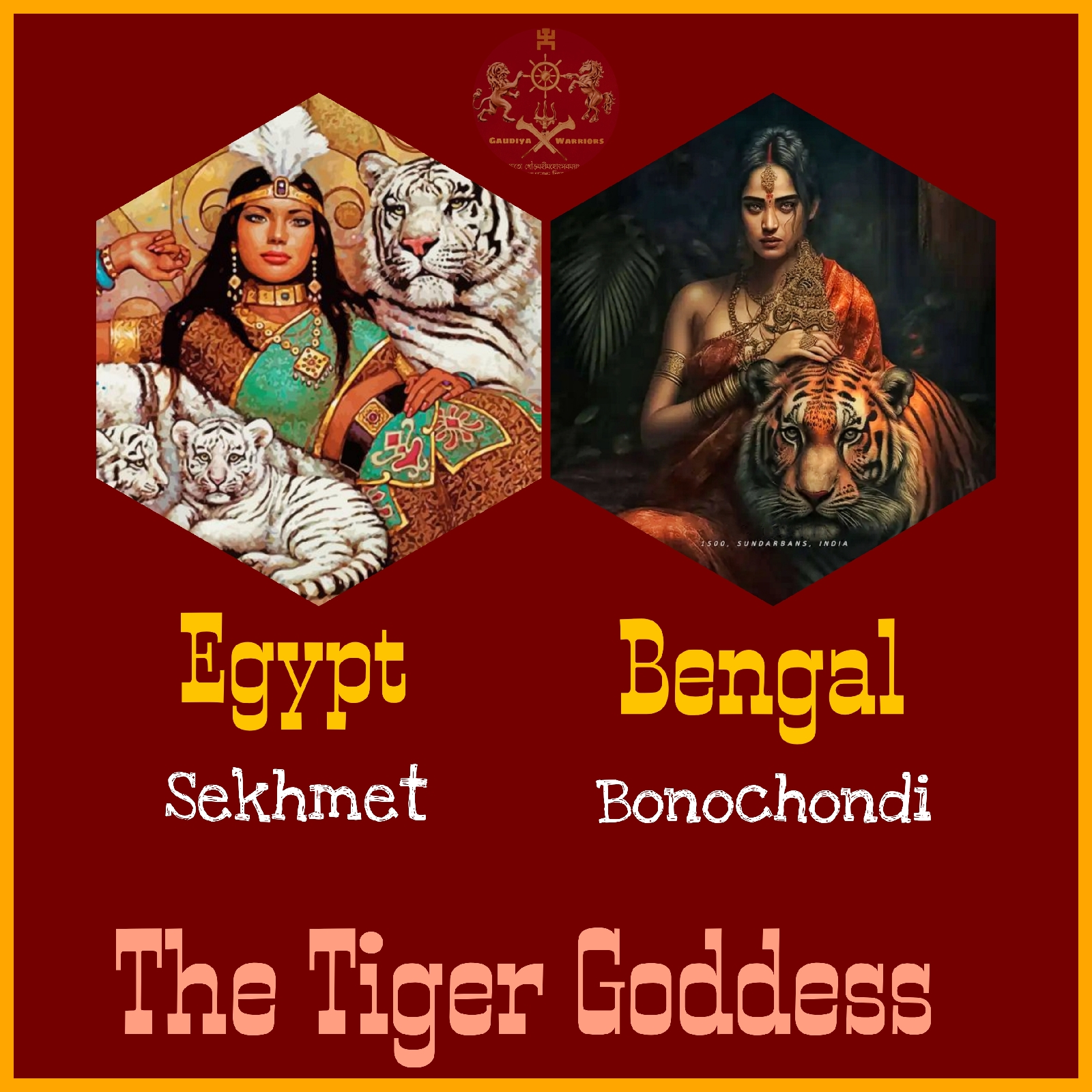
Image
Sekhmet (Ⲥⲁⲭⲙⲓ) was an ancient Egyptian war-goddess who was undoubtedly one of the most important goddesses in the Egyptian pantheon. As the deity of the ancient Egyptian pagan culture, he bears a remarkable resemblance to the deity of the Bengalis, Chō̂ndi. The Coptic Egyptians described the goddess Sekhmet as 'Mutaitis Lydima' (Sekhmet - the Bloodthirsty). Debi Chō̂ndi is always called "Rudhirapriya" in the Shakta culture of Bengal. Sekhmet was mainly idolized as a legion of lions, but in the sycamore forest of the Sinai Peninsula (سينا, Ⲥⲓⲛⲁ) in northern Egypt, she was deified as a tiger goddess, protecting the forest's inhabitants from tiger attacks.  In Bengal Goddess Chō̂ndi is always worshiped riding a lion, but in the Sundarbans forest of the Gangetic Delta in South Bengal she is worshiped as the tiger goddess Bō̂nō̂chō̂ndi. She is worshiped to protect the forest dwellers from tiger attacks. Due to the violent and demoni...

GajaLakshmi Worship in Gangaridai Civilization

Image
Worship of Debi Gõjõ-Lōkkhī in Gangaridae Civilization  🪙  Śubha Dhanatraẏōdaśī   🪙 On this day, the Vaishya merchant community of Bengal - the Baṇikas take a vow to worship their goddess GajaLakṣmī. During the heyday of the ancient Gangaridai civilization, the Gangazha merchants used to trade in Sinhala, Java, Sumatra, Rome, Greece, Crete with huge cargo ships and returned home with huge wealth. At that time, Pippali spice of Bengal was in great demand in the world. Pliny lamented that all Rome's gold would have been spent buying Pippali from the Gangaridai. Many famous merchants like Banik Chandrapati, Banik Pundarik, Banik Jambhalamitra, Banik Dhanpati Shresthi have traded in the foreign and the stories of their huge ships, Saptadingha, Madhukar Dinga have become legends. Picture : Gangaridai era Gaja-Lakshmi/Gõjõ-Lōkkhī murti from Chandraketugarh, West Bengal. Gold came from foreign trade, through the export of various cash crops of...

Ancient Durga Puja & Pratimas of Bengal

Image
|| Ancient Durga Puja & Pratimas of Bengal ||  1) Raja Surath's Durga Puja of Garh Jangal, Medhas Ashram, Treta yuga, Paschim Bardhaman [First Ever Durga Puja in World]. The Ashram of Medhas Muni _________________________________________ 2) Pandu Rajar Dhibi - Pakshi-Matrika (mother bird deity)  _________________________________________ 3) Gangaridae Era Dashayudha Matrika with Parshwa-Sahacharas, Chandraketugarh, 700 BC-100 AD  This Gangaridai era (BCE) antique from Chandraketugarh, Bengal depicting the Bali of male goat in front of Devi Dashayudha. Bali pratha is integral part of Durga Puja having it's deep rooted history.  _________________________________________ 4) Gupta era Dashabhuja matrika seal from Bengal.  _________________________________________ 5) Ashtabhuja Durga of Gaudeshwar Shashanka's rule , 7th Century ____...

Vishwakarma Worship in Bengal

Image
Worship of  Vishwakarma  in Bengal  🐘⛏️|| 𝐒𝐮𝐛𝐡𝐚 𝐁𝐢𝐬𝐡𝐰𝐚𝐤𝐚𝐫𝐦𝐚 𝐏𝐮𝐣𝐚 | |⛏️🐘 A Pala era Bengal style recreation of Devashilpi Vishwakarma by artist Shirsho Acharya   The worship of Bishwakarma have also distinct puja rituals in Bengal. In Bengal Bishwakarma is worshipped following the solar calendar. Vishwakarma is worshiped in Bengal on the day the Sun enters Virgo (usually September 17). Apart from the rest of India, his puja in Bengal also means the festival of kites. On this day kites are flown from every house. The first mention of Bishwakorma in eastern India was as the craftsman of Jagannath idol. Later, in Mansamangal Kavya, merchant Banik Chandrapati's son Lakhindar's iron palace craftsman was also this god artist. In Bengal he is actually worshipped as a Engineer god since ages. Bishwakarma said to have been constructed 'Divya Vimana' aircraft, for that Bengalis still celebrate his legacy by flying kites...

History of Ganesha Worship in Bengal

Image
*  ℙ𝕒𝕝𝕒 𝕖𝕣𝕒 𝔾𝕒𝕟𝕖𝕤𝕙𝕒 𝕎𝕠𝕣𝕤𝕙𝕚𝕡 : The first reference to the presence of the Ganapatya sampradaya in Bengal centered on Ganesha in from the Narayanpur idol inscription in the fourth year reign of Gaudeshwar Mahipala, when Buddhamitra, son of the merchant Jambhalamitra, habitant of Bilikandhaka under Samatata, erected a idol of Vinayaka-Bhattaraka.  The Narayanpur idol inscription of Gaudeshwar Mahipala l  The idol is quadrangular in black stone, bearing Moola, Japamala, Parashu and lotus. He is inhaling the scent of Padmapushpa through his trunk. So the worship of Siddhidata Ganesha was quite popular in the merchant communities of Bengal i.e the Baniks at that time. * 𝕊𝕒𝕘𝕒𝕣𝕕𝕨𝕚𝕡 : Ganesha worship at Sagardwip [Saugor island] claims the greatest antiquity. Gaudeshwar Nayapala's Sian insctiption records the construction of a silver-made Sadashiva idol, gold-made Chandika and Bighnanayak i.e. Ganesha i...

Manasa Cult in Bengal

Image
🐍 Manasā is the predominate goddess of the Dravidian race and since the majority of Bengal's martial casts are racially Dravidian, Mansa Puja has a dominant place in Bengal. The Aitarēẏa Āraṇyaka of the Rigveda mentions the arrival of the Naga-worshipping Chera people to the Ganges Valley in eastern India, the Shikhar Kshatriyas of the Rarha region, among whom Mansa Puja is most popular. Maharaja Janmējaẏa as mentioned in the Mahabharata invited Brahmins from the kingdom of Vanga (ancient Bengal) to perform Sarpa-yajña. In the Gangaridae era,  the conflict of Manasa with the famous Bengali merchant bull Parama-Shaiva Chandrapati Banik, [who was a devout Shiva worshipper Vaishya (V3) and refused to worship some female deity like Manasa] and the eventual establishment of Manasa as a goddess by receiving his puja are legendary. The single largest of the Pala era Matrika idols is of Manasa, because Manasa was the pivotal deity of the Gaudiya soldiers. In the Middle Ages, t...

Famous Rathayatras of Bengal, from Devotion, History & Heritage

Image
🏚️ Famous Rathayatras of Bengal, from Devotion, History & Heritage✨  1. Mahesh Rath Yatra :   The 2nd Biggest Rathayatra of World is the Māhēśh Rathayatra of Bengal, having been celebrated since 626 years. In 1396 Dhrubananda Brahmachari, a great Jagannath devotee started this Rathyatra in Mahesh, Srirampur. Sri Chaitanya christened Mahesh as 'Nava Nīlāchala'. 2. Bishnupur Rath Yatra : The 457-year-old Rathayatra of Bishnupur started under the patronage of the Malla dynasty kings of Bengal. Bishnupurraj Bir Hambir Malla built a stone chariot in 1565 AD. In the 17th century, Raja Bir Singha started the Rathyatra with procession. 3. Mahishadal Rath Yatra : One of the traditional Rathyatras of Bengal is of Mahishadal in Medinipur. The history of Mahishadal's Rathyatra is 256 y/o. The Queen of Mahishadal Rani Janaki built this chariot in 1766 AD. Referring to the diary of Dewan Anand Ghosh,...