Posts

Showing posts with the label Gaudiya Empires

Sahasrabahu - The Prince of Bengal Who Ruled Thailand

Image
●|| Sahasrabahu - The Prince of Bengal Who Ruled Thailand ||● The Aryan Hindu Civilization was brought to Thailand indeed by the Bengalees. As per history, Mahārājādhirāja Sahasrabāhu, the son of Baṅgarāja Siṁhabāhu, brother of Laṅkāpati Vijaẏa founded his dynasty in Thailand and granted the land a Sanskrit name Śyāmadēśa 🇹🇭 Most of us are familiar with the legendary tale of Prince Vijaya, the eldest son of King Simhabahu of the ancient Bengali kingdom of Singhapura, who sailed to Sri Lanka and established the Sinhala royal dynasty. His story is well documented in Sri Lankan chronicles such as the "Mahavamsa" and "Dipavamsa". However, what remains less known is the remarkable journey of his younger brother, Prince Sahasrabahu, who, much like his elder brother, played a crucial role in expanding Bengali influence in Southeast Asia. Historical traditions and cultural imprints suggest that Prince Sahasrabahu sailed eastward and laid the foundations of wha...
Pandit Srimantanarayana Rayamukhuty, Bhurishrestha

Image
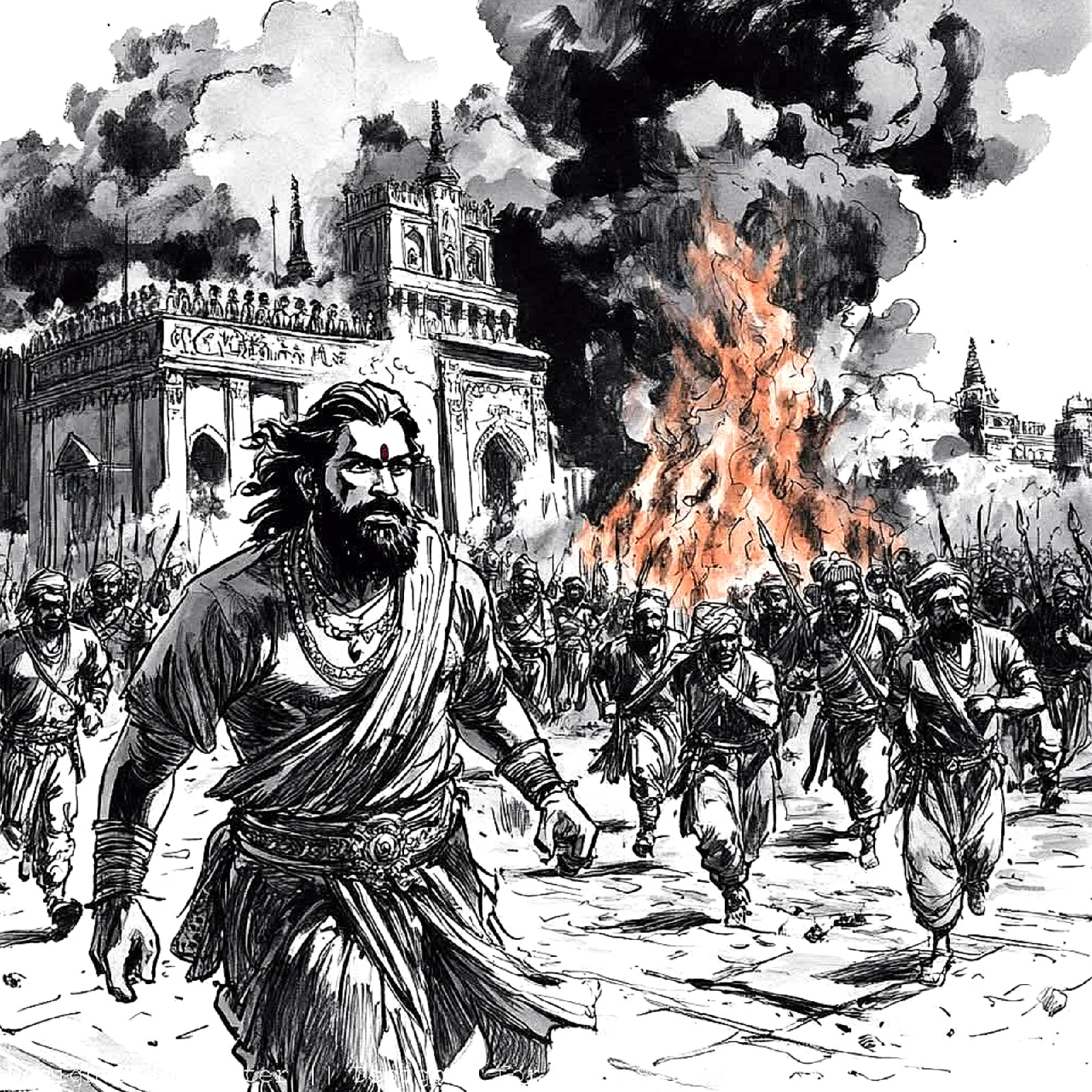
♕ Rājasēnādhyakṣa Śrīmantanārāẏaṇa Rāẏamukhuṭi ♕ Bhūriśrēṣṭha Sāmrājya, Bāṅgālā, 15th Century 𓊹 [ Art : Enraged, Pandit Shrimantanarayan thundered and ordered his mighty Bhurishrestha Army to annihilate the Pathan soldiers.  Picture collected from the newly published book 'Raibaghini' of Avik Sarkar; Publishers: Patrabharati; Collect from Kolkata Book Fair, 2025 ] The Mahāsēnāpati Srimantanarayana was a man of immense strength, skill in war and extraordinary intelligence. Although he had obtained a separate territory, he was the right-hand of his elder brother, Maharaja Srikrishnarayana Rayamukhuty, and it was on his advice that Srikrishnarayana conducted all the affairs of the kingdom. Senapati Srimanta, with the brave army of Bengal, skillfully and bravely defeated the Ilyas Shahis and reclaimed the entire territory from the eastern border of Medinipur to the seashore. His well-equipped fleet used to float on the Damodar and Rupnarayana rivers, blocking the progr...

Mahanavika Buddhagupta - The Bengali Merchant turn Monarch who Established Hindu Kingdom in Malaysia

Image
Mahanavika Buddhagupta - The Bengali Sailor-Merchant Who Ruled Malaysia  We all are aware of the story of the conquest of Sri Lanka and the establishment of the Sinhalese kingdom with the 700 boats of prince Vijaya Singha of the Simhapura kingdom of Bengal. Especially in several countries of South and Southeast Asia, there are many traces of the ancient Bengali raids and colonization or establishment of independent kingdoms. In fact, Aryanism and Hindu civilization entered countries like Vietnam, Malaysia, Cambodia, Indonesia through the arrival and colonization of the Bengalis. The influence of which can be seen in the continuous influence of Gaudiya style in the temple-architecture of the respective countries.  Bengali architects are the builders of several large temples like Onkarnath (Ankorvat), the world's largest temple, or Barbudhar (Borobudur) temple. So the poet Satyendranath Dutta proudly said - “শ্যাম কম্বোজে ওঁঙ্কারধাম মোদেরই প্রাচীন কীর্ত্তি।”. Vijaya ...

Maharaja Sri Bir Hambir Malla Deva

Image
Maharaja Sri Bir Hambir Malla Deva  [1565-1620], the 49th Monarch of Mallabhum kingdom & the greatest ruler of the Malla dynasty of Bengal Official portrait of Maharaja Sri Bir Hambir Malla Deva of Mallabhoom,  Portrait - Arghyadeep Sardar, c. Gaudiya Warriors  The Mallabhum kingdom under the rule of Maharaja Bir Hambir Malla was spread upto the Santhal Pargana's Damin-i-Koh in the north, Midnapore in the south, Bardhaman in the east & Chotanagpore in the west.   Bir Hambir Malla's ruling period is regarded as the golden era of Mallabhum. Being a wise, brave & expert king he constructed several forts, organized the Malla army & dug seven deep trench encircling the capital city of Bishnupur.   Being a pious Gaudiya Vaishnava ruler he patronized Padavali poets & kirttaniyas, constructed 108 temples & defeated Pathans to protect Dharma. In his era Bishnupur became second Vrindavan named 'Gupto Brindabon' ....

Gaudadhipati Shashanka

Image
The rise of Independent kingdom started with the calamity met by Mahasenagupta, of later Gupta dynasty at thee hands of Kalachuri king Sankaragana.  two invasions led by Tibetan King srong Tsan and Chalukya Kirtivarman dismemebered the later Guptas. Shashanka declared Independence and started his own conquests. He set up his capital at Karnasuvarna, and became the master of Entire Eastern India. his dominions included Magadh till Chilka lake and entire Bengal.  The tussle against Kamrupa that existed since Mahasenaguptas reign was also continued.  The arch rivalry that existed between Maukharis and Later Guptas was also continued by Shashanka, who vowed for revenge. With Pushyabhutis allying with Maukharis and Mahasenagupta, Shashanka, secured alliance with Devagupta and Pulakeshin II. Devagupta had Maukhari Grahavarman killed. and this brought Pushyabhuti Rajyavardhan to the scene.  Shashanka, brought his army till kannauj to help his ally, h...

Prince Vijaya & the Bengali Ancestry of Sri Lankans

Image
Just look at the history of how a Indian community named Bengalis migrated & colonized the island of Sri Lanka & established Independent kingdom.  * Prince Vijaya Singha Prince Vijay Singha is the first historical king of Sinhala who was a Bengali prince from the kingdom of Sinhapura. According to the Mahāvamśa, an ancient chronicle of Sri Lanka’s kings written in Pali, there was a kingdom named Singhapura in Vanga, located in the  south-western way Rarh region of Bengal, that's todays Singur in the Hooghly district in West Bengal state of India. The Bengali Prince of Sinhapura named Vijaya Singha sailed on 8 ships to Sri Lanka with 700 of his people in 22 April 543 BC and established the kingdom of Sinhala. Legend describes the Sinhalese as descendants of Vijaya and his people, who would have lived in parts of Sinhapura & Tamralipta port, today’s Hooghly & Purba Medinipur districts of West Bengal. The Mahavamsa mentions another town in Rarh called ...

Gaudeshwar Vishwarup Sena - Bengal Monarch who erected Victory Pillars at Varanasi defeating Mamluks

Image
Gaudeshwar Vishwarup Sena - Sena dynasty Monarch of Bengal who erected Victory Pillars at Varanasi defeating Mamluks Arirāja-Ghātukaśaṅkara SaGargaYavanānwaẏaPralaẏaKālarudra ParamaSaura Gauṛēśwara Viśwarūpa Sēna was the sixth Monarch of the Chandrakūla Sena dynasty of Bengal in the 13th century. He was the son of Parama-Narasimha Gaudeshwar Lakshman Sena and Maharani Vasudevi and the youngest prince of Sena kingdom. In 1212 Emperor Vishwarup Sena defeated the ruling Mamluk Sultan of Delhi Shamsuddin Iltutamish, conquered & liberated Varanasi Kashi-Vishwanath temple, established victory pillars {𝘷𝘪𝘫𝘢𝘺𝘢 𝘴𝘵𝘢𝘮𝘣𝘩𝘢} in Kashi and declared Kashi as the land of Shiva-Vishweshwara {The Lord of All}. Gaudeshwar Vishwarup Sena entering Varanasi with his Royal Navy, portrait by Gandaberunda From his copperplate grants of Madanpara, Idilpur and Dhaka are mentioned the glorious time of his reign, the expansion of his vast Empire up to Varanasi and the conques...

Samudratanaya Gaur Govinda - Hindu Monarch of Sylhet who defeated Turkic Invaders 3 times

Image
Hindu Resistance of Ishan-Vanga Srihatta - Samudratanaya Maharaja Gaur Govinda -  the Hindu Monarch of Srihatta of defeated Turkic Invaders 3 times  Samudratanaya Maharaja Sri Gour Gobinda Srihattadhishweravyah Samudratanaya Maharaja Gauda Govinda (শ্রীহট্টাধীশ্বেরভ্য: সমুদ্রতনয় মহারাজ গৌড় গোবিন্দ/श्रीहट्टाधीश्वरव्य: समुद्रतनय महाराज गौड़ गोविंद)  was the 21st Monarch of medieval Srihatta janapada's  Gour Kingdom  in the Ishana-Vanga. He is described as a very conservative  Hindu  ruler whose reign started in 1260. He is honoured for his tremendous military power and for defeating the Turk invaders of Lakhnauty three times.  In early thirteen century, Sribhumi was ruled by Maharaja Jayananda. His three sons Srinanda, Upananda and Govardhan became embroiled in a quarrel. This conflict gradually took the shape of a civil war. After defeating Upananda, Maharaja Gaur Govardhan became the ruler of Brahmachal. He ruled...

Rule of the Bengalis on Himachal - Pala dynasty & Sena dynasty

Image
Rule of the Bengalis on Himachal - Pala dynasty & Sena dynasty  The Royal Chronicles of Himachal kings called the 'Banshavali', which was published by A.F.P. Harcourt in his Himalayan Districts of Kooloo, Laboul and Spiti (1871) but which is no longer available, claims to bridge both the early and later periods of Kullu's history; for while the last Kullu ruler flourished in the nineteenth century A.D., the first one, the founder of the dynasty, is presented in the genealogy as having lived at a remote period. The Banshavali records the names of total 88 Bengali kings who ruled in Kullu of Himachal. These eighty-eight kings are all said to have belonged to one and the same dynasty, there having been no change of dynasty throughout the entire period, although the kingdom did not always pass down from father to son. The first seventy-three kings had the suffix Pall the seventy-fourth, Siddha Pal added Singh to his name, and Siddha Pal Singh's fourteen succ...