Posts

Showing posts with the label Ethnic Connections

Sahasrabahu - The Prince of Bengal Who Ruled Thailand

Image
●|| Sahasrabahu - The Prince of Bengal Who Ruled Thailand ||● The Aryan Hindu Civilization was brought to Thailand indeed by the Bengalees. As per history, Mahārājādhirāja Sahasrabāhu, the son of Baṅgarāja Siṁhabāhu, brother of Laṅkāpati Vijaẏa founded his dynasty in Thailand and granted the land a Sanskrit name Śyāmadēśa 🇹🇭 Most of us are familiar with the legendary tale of Prince Vijaya, the eldest son of King Simhabahu of the ancient Bengali kingdom of Singhapura, who sailed to Sri Lanka and established the Sinhala royal dynasty. His story is well documented in Sri Lankan chronicles such as the "Mahavamsa" and "Dipavamsa". However, what remains less known is the remarkable journey of his younger brother, Prince Sahasrabahu, who, much like his elder brother, played a crucial role in expanding Bengali influence in Southeast Asia. Historical traditions and cultural imprints suggest that Prince Sahasrabahu sailed eastward and laid the foundations of wha...

Mahanavika Buddhagupta - The Bengali Merchant turn Monarch who Established Hindu Kingdom in Malaysia

Image
Mahanavika Buddhagupta - The Bengali Sailor-Merchant Who Ruled Malaysia  We all are aware of the story of the conquest of Sri Lanka and the establishment of the Sinhalese kingdom with the 700 boats of prince Vijaya Singha of the Simhapura kingdom of Bengal. Especially in several countries of South and Southeast Asia, there are many traces of the ancient Bengali raids and colonization or establishment of independent kingdoms. In fact, Aryanism and Hindu civilization entered countries like Vietnam, Malaysia, Cambodia, Indonesia through the arrival and colonization of the Bengalis. The influence of which can be seen in the continuous influence of Gaudiya style in the temple-architecture of the respective countries.  Bengali architects are the builders of several large temples like Onkarnath (Ankorvat), the world's largest temple, or Barbudhar (Borobudur) temple. So the poet Satyendranath Dutta proudly said - “শ্যাম কম্বোজে ওঁঙ্কারধাম মোদেরই প্রাচীন কীর্ত্তি।”. Vijaya ...

Rayashrestha Pratapaditya's Jashore Raj-Dorbar Description by Jesuit Missionaries

Image
⚜️】 Description of Rayashrestha Maharaja Pratapaditya and Jashōr Rāj-dôrbar in Jesuit Missionary Chronicles 【⚜️ At the end of 16th century several Jesuit missionaries from Portugal visited the Kingdom of Jashōr (m. Chandecaen) to establish trade with Bengal. In 1598, Father Franciseus Fernandez from Porto de Grandé sent Dommicus Sosa in Chandecan who narrated the Chronica primária.  On 20 November 1599, two Jesuit missionaries Melchiorem Fonsecom and Andreãm Boues arrived in Jessore. On Monday they were allowed to visit the Raj-dôrbar of Jashor and to meet the coveted ruler Maharaja Pratapaditya. 📜 The missionary chronicles mentions that, Rayashrestha Pratapaditya, the King of Chandecan (Jessore) was tall, broad shouldered and of strong build with well developed muscles. He was of fair complexion, with a broad thick moustache and a scar on the right side of his forehead. 📜 India Orientalis mentions the missionaries gifted  offe...

Bengali Ceremonial in America - Charak Puja

Image
Bengali Ceremonial in America - Charak Puja Festival in Mexico. ~ photo - National Museum  From remote antiquity the American continent and its inhabitants were known to the adventurous Bengali Hindu colonists, traders, gold and silversmiths, religious preachers and messengers of culture, who were responsible for the spread of similar forms of cult, civilisation and religious philosophies whose immortal imprints have been dis- covered all over the vast continent of America. Bengali Ceremony in America -Hewitt, referring to the practice of penance in India and America, writes: "It is still preserved in India, in the ceremony of swinging the young sun-god in August; also the Dakota (U.S.A.) swinging- penance is exactly like that annually performed in Bengal by the devotees, who swing themselves on hooks at the Charak-pooja, while the preparations for cutting down the mystery tree are very like those observed in Chota-Nagpore, in cutting down the K...

Sekhmet & Chondi - Cultural Connection of Bengal & Egypt

Image
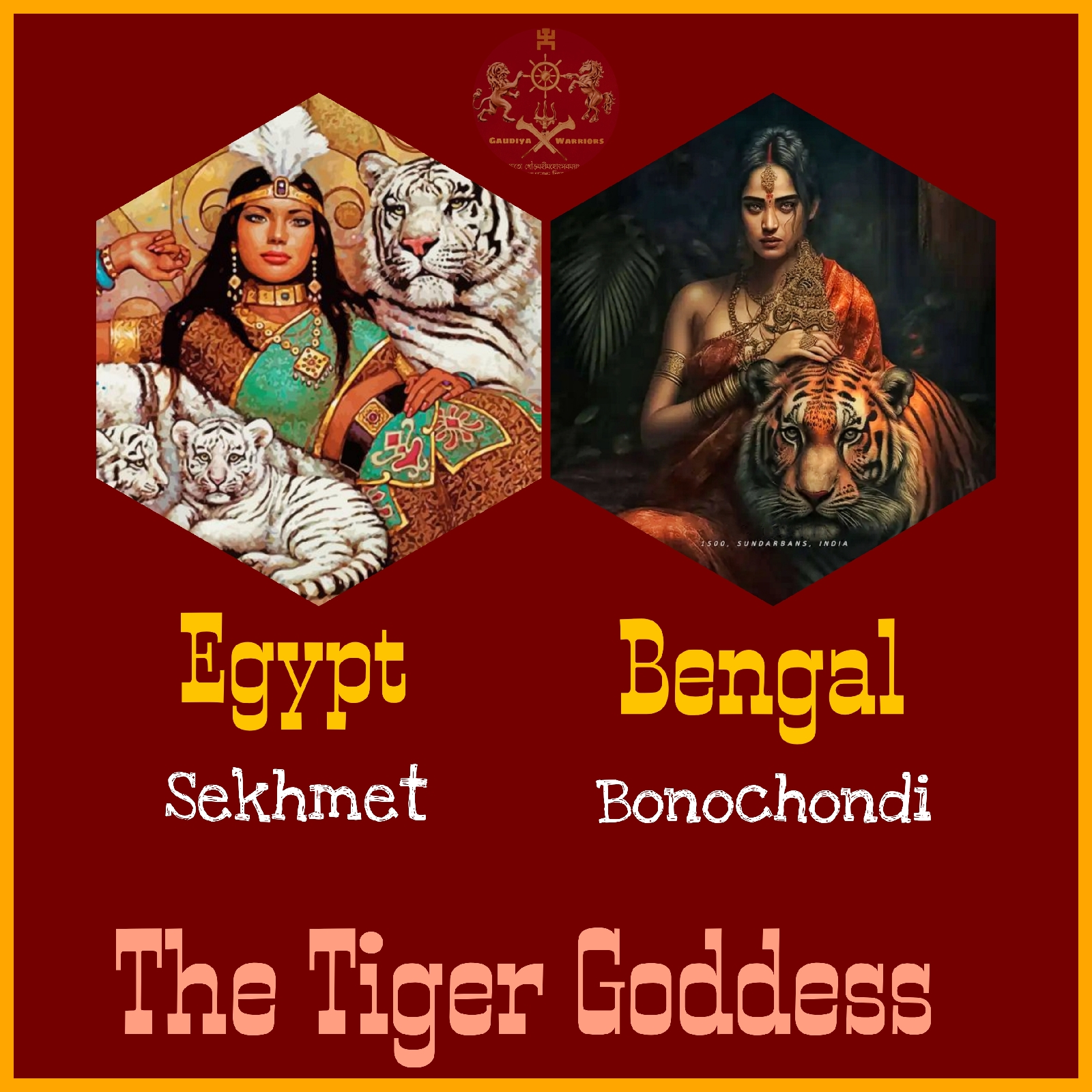
Sekhmet (Ⲥⲁⲭⲙⲓ) was an ancient Egyptian war-goddess who was undoubtedly one of the most important goddesses in the Egyptian pantheon. As the deity of the ancient Egyptian pagan culture, he bears a remarkable resemblance to the deity of the Bengalis, Chō̂ndi. The Coptic Egyptians described the goddess Sekhmet as 'Mutaitis Lydima' (Sekhmet - the Bloodthirsty). Debi Chō̂ndi is always called "Rudhirapriya" in the Shakta culture of Bengal. Sekhmet was mainly idolized as a legion of lions, but in the sycamore forest of the Sinai Peninsula (سينا, Ⲥⲓⲛⲁ) in northern Egypt, she was deified as a tiger goddess, protecting the forest's inhabitants from tiger attacks.  In Bengal Goddess Chō̂ndi is always worshiped riding a lion, but in the Sundarbans forest of the Gangetic Delta in South Bengal she is worshiped as the tiger goddess Bō̂nō̂chō̂ndi. She is worshiped to protect the forest dwellers from tiger attacks. Due to the violent and demoni...

Prince Vijaya & the Bengali Ancestry of Sri Lankans

Image
Just look at the history of how a Indian community named Bengalis migrated & colonized the island of Sri Lanka & established Independent kingdom.  * Prince Vijaya Singha Prince Vijay Singha is the first historical king of Sinhala who was a Bengali prince from the kingdom of Sinhapura. According to the Mahāvamśa, an ancient chronicle of Sri Lanka’s kings written in Pali, there was a kingdom named Singhapura in Vanga, located in the  south-western way Rarh region of Bengal, that's todays Singur in the Hooghly district in West Bengal state of India. The Bengali Prince of Sinhapura named Vijaya Singha sailed on 8 ships to Sri Lanka with 700 of his people in 22 April 543 BC and established the kingdom of Sinhala. Legend describes the Sinhalese as descendants of Vijaya and his people, who would have lived in parts of Sinhapura & Tamralipta port, today’s Hooghly & Purba Medinipur districts of West Bengal. The Mahavamsa mentions another town in Rarh called ...

Bengal-Tamil Connection : Coins & Clans

Image
💠 BENGAL-TAMIL CONNECTION 💠  [Image 1 : Gaudiya scripts or Bangla alphabets along with Fish symbol on the coin of King Uttamachola of Chola dynasty] The Bengali connection with Tamils was first discussed when the Gaudiya script or Bengali alphabet was found on the coins Parakesari Madurantaka Uttama Chola (971-985 AD), son of Gangaraditya. Later, various mythological sources suggest that the origin of the Tamils ​​was in the Tamalitti (Tamralipta) port of the south-western region of Bengal, and the name Tamil is a short form of the Prakrit word Tamalitti. The Tamraliptas mentioned in the Vayupurana and Vishnupurana were the inhabitants of Bangala and the adjacent sea coast who migrated from Tamalitti (Tamaralipti) and went to South India to form the new Tamil nation. The name Tamil appears to be only an abbreviation of the word Tamalitti. The Tamraliptas were inhabitants of Bengal & adjoining sea coasts in the Vayu and Vishnu Purans. They were known as Tamil, most...

Bengal-Portugal Connection : The Gallant Commanders

Image
Bengal-Portugal Connection : The Gallant Commanders  ☣️ || 𝕿𝖍𝖊 𝕭𝖊𝖓𝖌𝖆𝖑-𝕻𝖔𝖗𝖙𝖚𝖌𝖆𝖑 𝕮𝖔𝖓𝖓𝖊𝖈𝖙𝖎𝖔𝖓 || ☣️ The Portuguese first set foot in Bengal in the first half of the 16th century, for the purpose of trade because of the then world demand for finest Maslin textile industry of Bengal. Entering through the Sundarbans Straits in the western part of Bengal, they took permission from Maharaja Satyanarayan Rayamukhuty in Bhurishreshta kingdom and built a settlement at Saptagram (Satgaon) port on the banks of the Hooghly River. On the other hand, they built business centers in Dhaka and Chattagram (Chittagong) in Eastern Bengal. They call the two ports in two different side by two names - ⛵ ∆ ℂ𝕙𝕒𝕥𝕥𝕒𝕘𝕣𝕒𝕞 (Chittagong) - Porto de Grande  ⛵ ∆ 𝕊𝕒𝕡𝕥𝕒𝕘𝕣𝕒𝕞 (Satgaon) - Porto de Pequeno From the late 16th century to the 17th century, they served as mercenaries in the armies of the kings of Bengal in their war against the Mughals. Firstly man...

Rule of the Bengalis on Himachal - Pala dynasty & Sena dynasty

Image
Rule of the Bengalis on Himachal - Pala dynasty & Sena dynasty  The Royal Chronicles of Himachal kings called the 'Banshavali', which was published by A.F.P. Harcourt in his Himalayan Districts of Kooloo, Laboul and Spiti (1871) but which is no longer available, claims to bridge both the early and later periods of Kullu's history; for while the last Kullu ruler flourished in the nineteenth century A.D., the first one, the founder of the dynasty, is presented in the genealogy as having lived at a remote period. The Banshavali records the names of total 88 Bengali kings who ruled in Kullu of Himachal. These eighty-eight kings are all said to have belonged to one and the same dynasty, there having been no change of dynasty throughout the entire period, although the kingdom did not always pass down from father to son. The first seventy-three kings had the suffix Pall the seventy-fourth, Siddha Pal added Singh to his name, and Siddha Pal Singh's fourteen succ...